Friday, 16 September 2011

Caring for Your Pet Conure

Some tips to ensure a long happy relationship with your pet conure...

Social Interaction
Conures are very sociable by nature, and love interacting with their owners, which is one of the reasons they are so popular as companion birds. However, because they constantly crave human interaction, they can be quite demanding of your time and attention. Hand-raised conures make fantastic pets, mainly because they are imprinted on humans, and quite honestly, believe that they are human. Some species, such as the sun conures, can become extremely vocal in their efforts to get your attention, and this is something that should be considered before taking on the responsibility of a bird that requires lots of love and attention. If you are unable to commit a good deal of your time to a companion that will reward you with lots of pleasure, then rather consider getting a less demanding pet, as a neglected conure will result in stress for both the bird and the owner.

Diet
It is best to provide your conure with a well balanced diet consisting of whole grain cereals, fruit, vegetables, nuts and seeds to keep it in a healthy condition. Commercial seed and pellet mixes should be supplemented with fresh fruit and veggies. Fresh apple, corn on the cob and sprouted seeds will all be relished by your pet conure. Commercial pigeon mixes, consisting of corn, a variety of peas, and sunflower seeds can be cooked up and fed to your conure as a healthy part of his daily diet. Avoid feeding you conure milk products, which can cause sour crop. Chocolate, alcohol, and onions are also a no-no, and avocado pear, is highly toxic to parrots, and can kill your bird instantly, so never ever let your bird eat avo.

General Health
Keep you conure's cage away from draughts and out of direct sunlight. Place his cage in a central area of the house so that he is part of daily household activities. Tobacco smoke, aerosol fumes, and household cleaners can all negatively affect your bird's health, so try to avoid these around your bird where possible. Your bird needs plenty of sleep, so if you are a night owl, make sure your bird's cage is covered, and placed in a quiet dark corner at night time so that he rest undisturbed. If your conure is going to spend a lot of time out of his cage, consider trimming his wings so that he cannot fly off into the sunset. This is for his own good, as he may fly into a window and injure, or even kill himself; or fly off, where his chances of survival are limited. If your bird is to be housed in an aviary, then wing trimming is not recommended, as free flight is necessary.

Choosing a Cage
Although conures are small in size, they require a fairly large cage as they are active birds and require lots of stimulating toys to prevent them becoming bored. A small cage would quickly become too cluttered and restrict their movement. There are some wonderful cages on the market that offer open-up play-tops or play-gym combinations allowing your bird to move in and out of the cage freely. Choose a sturdy cage, that will withstand the wrath of your conure's beak. When choosing a cage, avoid painted or plastic coated wire cages as your conure will chew at the bars and can ingest this, which can compromise his health. Choose a cage with a bar spacing suitable for the size of your bird. Smaller conures require cages with a narrow gap between bars to prevent them escaping. Finally, look for a cage that is easy to clean.
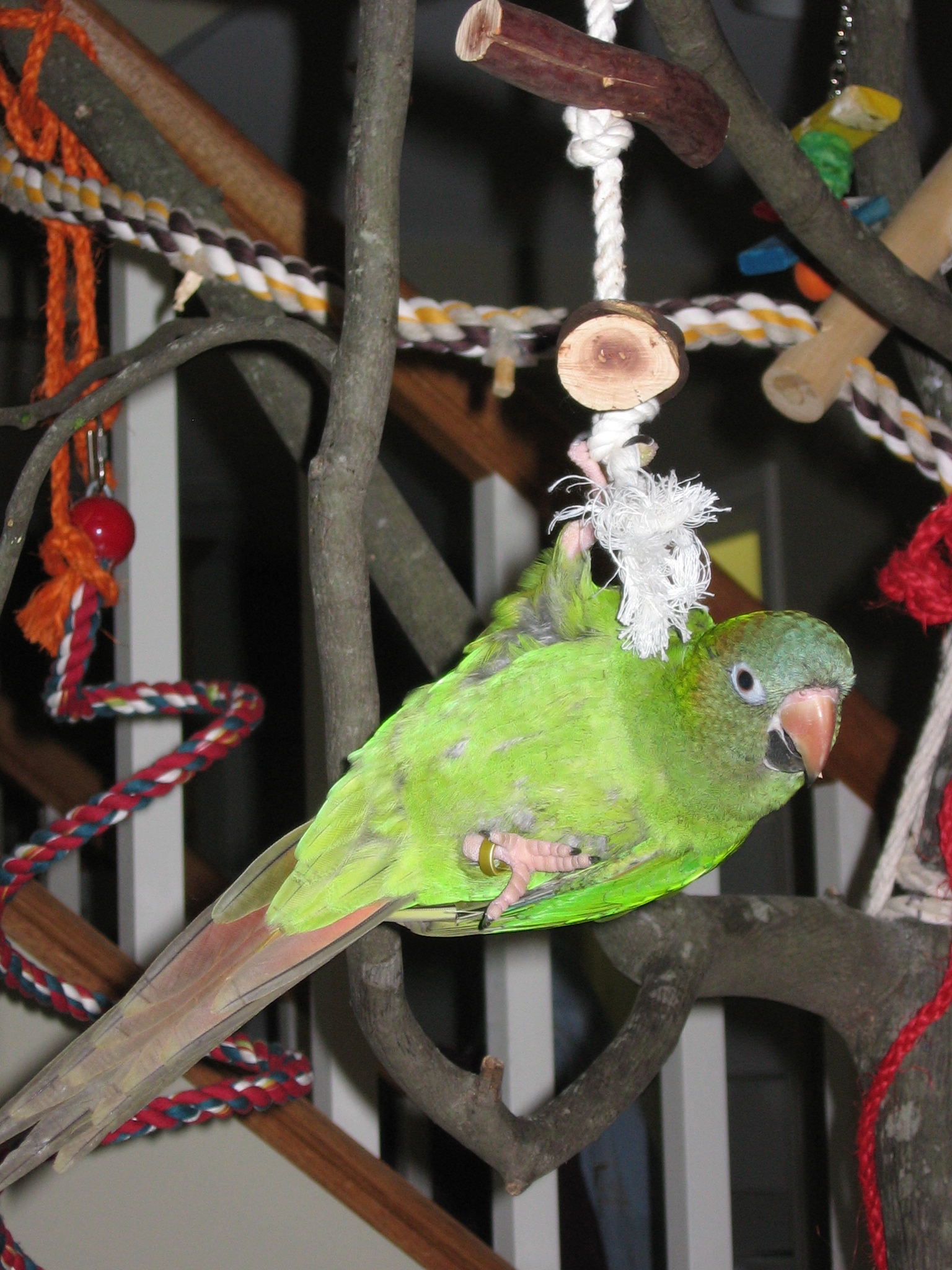
Conure clowing around (Photo: Richard)
Toys
Conures are extremely playful, intelligent, and active, so provide a range of toys to keep them stimulated. These can included chew toys, such as rawhide and wooden toys; things they can climb on, such as ropes, chains, and wooden ladders; toys that make a noise, such as bells and shakers; and swings, which give them hours of pleasure, and provide good exercise too.

Playtime
Conures are extremely playful and fun-loving. They have a mischievous air about them, and can be real clowns. They are intelligent and will learn tricks very quickly. They often roll over onto their backs in the palm of your hand. Conures also tend to be real water babies, so keep a spray mist bottle handy in hot weather, and provide a bird bath for them to splash around in. They will even join their owners in the shower, but just be careful not to overdo it, and make sure they dry off in a warm, draught-free area.


Thursday, 15 September 2011

Conures: Small Parakeets with Big Personalities


Conures come in a variety of species, sizes and colours. They are all full of character and make excellent companion birds and are thus popular as pets.

Lets take a look at some of the more popular types of conure that are kept as pets.

Sun Conure (Photo: Sarah G)
Sun Conure
The sun conure must be one of the most beautiful birds on the planet. With its bold predominantly yellow body, accentuated with bright orange highlights on the head and underbelly, green splashes of colour over the back and wings, and deep blue highlights on the tips of the wings and tail, this a truly stunning bird to behold. It is one of the medium sized conures, but what it lacks in size it makes up for in personality and voice. Although they tend to be rather screechy, sun conures are very alert birds, and this characteristic makes them very good “watch dogs” as they will alert you to anyone approaching your property. They are very loving and playful, and love to snuggle into their owners neck. They can also be quite demanding as they crave constant attention. The sun conure requires lots of love and companionship, and as it is quite a noisy bird, it is not recommended for those that have neighbours living in close proximity.

Jenday Conure
The Jenday Conure is often confused with Sun Conure as they are very similar in both size, colour, and character. However, the colouration of the Jenday Conure, is set out in distinct patches of colour as apposed to splashes of colour coving the entire body. It has a bright yellow head, with bright green on top of the body and wings, while the underside is a deep orange to red, with green and blue tail feathers.

Maroon Bellied Conure (photo: Dario Sanches)
Maroon Bellied Conure
The Maroon Bellied Conure is a small conure, with a dark green body, and a yellow-green striped chest. Not surprisingly, its belly is maroon, while the wing feathers are blue-green in colour, and the tail is green on the upper side and maroon on the underside. It has a patch of light brown on both the sides of the head. These little conures are very sociable, and like most conures they are extremely intelligent, affectionate, love to play, and will constantly seek attention and interaction with other birds and/or their owners. Their social nature makes them suitable for communal aviaries. The maroon bellied conure is one of the quieter conures, which generally are notoriously noisy birds. Their less vocal nature makes them the perfect companion for apartment dwellers as they tend to natter and chatter away rather than screech for attention.

Green Cheeked Conure
The Green Cheeked conure is often confused with the Maroon Bellied Conure as they are very similar in colour and nature. However, while the Green Cheeks also have a predominantly green body, they have grey breasts, maroon tails and blue primary flight feathers. The top of the head is a dark grey colour, and as their name suggests, they have green cheeks.

Peach Fronted Conure (Photo: Otavio Nogueira)
Peach Fronted Conure
The Peach Fronted Conure has a predominantly bright green body, with a grey-green chest, with the underside being a light shade of green. The top of the head is bright orange, with blue extending down the sides of the crown around the eyes. The rest of the head, body and tail is green, with blue tips on the tail and black tips on the wings, and a black beak that distinguishes it from the Orange Fronted and Half Moon conures. The Peach Fronted Conure is a very sweet natured parrot. Like all conures, it loves to cuddle and play. They also tend to be fairly quiet as conures go, so will make an ideal companion for apartment dwellers or those not partial to the demanding nature of some of the other conure species.

Patagonian Conure (photo: whiskymac)
Patagonian Conure
The Patagonian Conure is the largest of the conures species, and can reach up to 20 inches in size. The body colouration is mostly olive green-brown, with a grey chest, a patch of bright orange-red on the belly, and red “socks” on the legs. It has a ring of white around the neck, and blue edged wing feathers. Patagonian conures tend to be extremely vocal, and while their noise may not be welcomed by everyone, the upside is that they make good talkers. They have the playful, affectionate nature of the smaller conures, combined with the large size and ability to mimic and talk, which makes them popular pets.

If you are looking for a wonderful affectionate companion bird, the conures come highly recommended. Their smaller size make them easy to keep, and while some species tend to be rather noisy, they have great personalities that tend to overshadow this minor irritation. As they are highly intelligent and playful by nature, they need to be provided with plenty of toys for stimulation, and a cage large enough to accommodate them and all their "parrotphernalia".

Monday, 5 September 2011

Dog Arthritis

Unfortunately arthritis is a disease that isn't just inflicted upon the human race. Sadly it is a very common medical condition in both humans and animals. Essentially it is an inflammation in a joint, and it can affect any part of your dog's body. The major effects are pain, problems in moving, and swelling of the joints. The wear and tear of normal daily use of the joints is a big reason. Other reasons can be obesity, joint infections, dislocation, immune system illness, muscle, ligament or tendon injury.

The most common breed of dogs that suffer from this disease are Retrievers, German Shepherds and Labradors as arthritis is also an inherited disease. Each joint has two or more bones near each other. At the end of these bones is articular cartilage this gives a smooth area for the bones to move against each other. A thick fluid in the joint acts as a lubricant and shock absorber, and this then helps to protect the bones from any kind of grinding action. As the arthritis develops, the cartilage becomes rough and worn, and the joint fluid starts to thin and become watery. Movement becomes uncomfortable as there is less lubrication and smoothness in the joint, as the cartilage continues to wear away, bone will eventually rub on bone.

So how can you give your dog the best chance of avoiding arthritis later in life? Firstly weight control is vitally important. We all love to spoil our pets but their health should come before anything else. Obesity puts a massive strain on your dogs joints and limbs. Losing a bit of extra fat will provide immediate relief. The extra weight will cause the cartilage to disintegrate rapidly. There are cases of overweight dogs developing arthritis as young as 5 years old, so look after them now. Keeping them weight free gives them a better chance in their senior years to bypass arthritis.

Keep your dog active. The onset of arthritis in your dog can be delayed with plenty of exercise. A walk around the streets isn't really enough. A good run in the local park will keep their weight down and keep their joints limber. The natural fluid in the body will help to lubricate the joints and limbs. However, if your dog already has arthritis then little and often is more appropriate. When walking if your dog stops to rest don't push them to do more. Two walks a day, no longer than fifteen minutes each should help. Keep your dog on easy routes such as flat, smooth paths, no hills. Just as humans find swimming helps arthritic joints, so do dogs. Also they usually enjoy it.

Obviously once arthritis has set in you can't do anything to cure it. All you can do is help prevent it from developing too quickly. You can make your dogs life easier by giving them a soft bed with an orthopaedic foam base. Most pet shops and pet sites have a good selection to choose from. Brush their coat where they may have difficulty in reaching. Keep their bowls at a slightly higher level than before so they don't have to strain to feed. A healthy diet will also provide nutrients that your dog needs. There are many brands of pet food that now cater for senior dogs.

In terms of medications and herbal supplements to help with your dogs arthritis, it is always best to consult your vet.